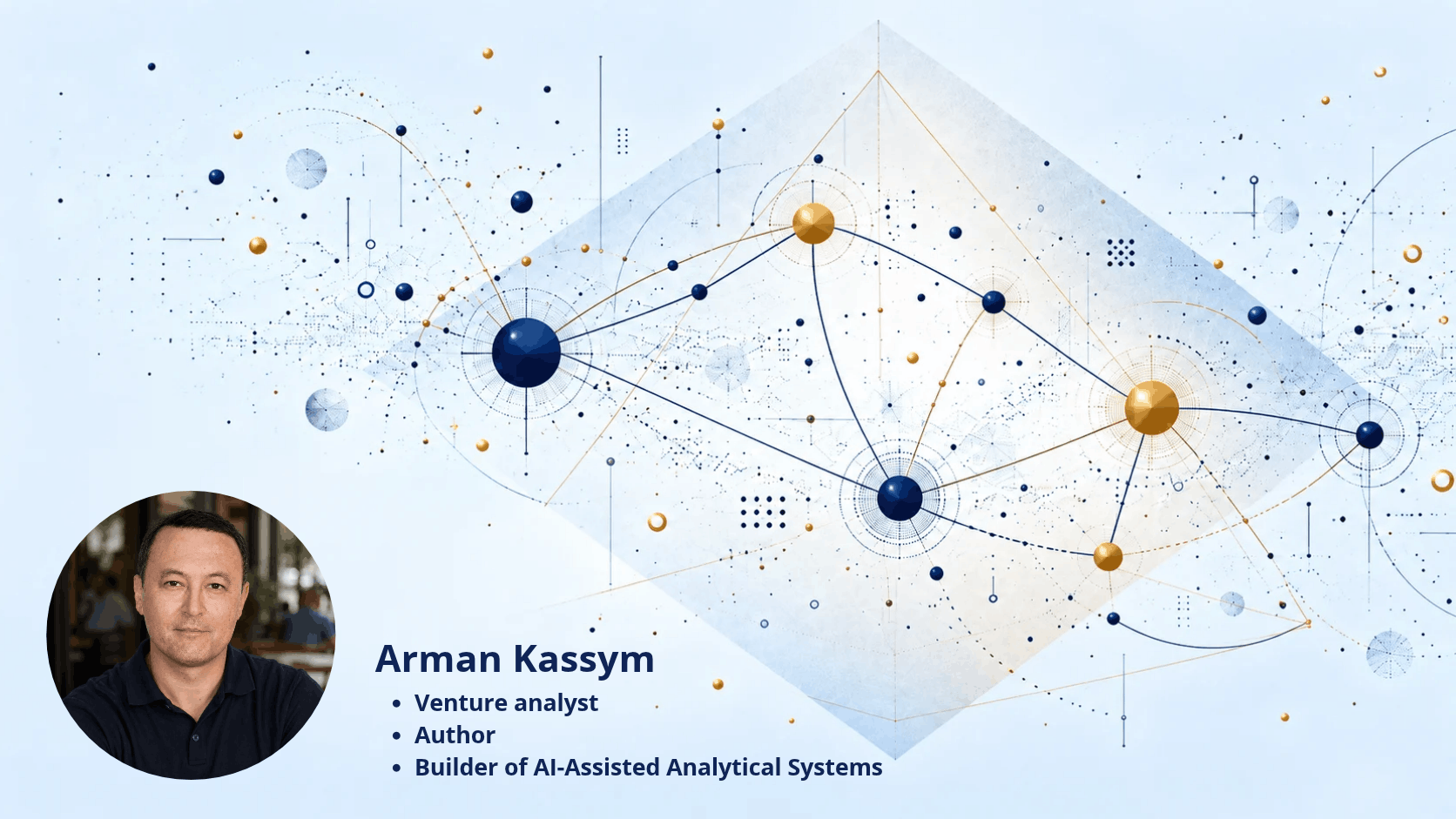
About
I have spent much of my professional life building companies and, later, evaluating them before they become easy to read.
Before moving primarily into venture analysis, I founded and led three companies and co-founded a business association in Kazakhstan. All three companies reached leading positions in their respective markets. One was named among the industry leaders in a study by the United Nations Development Programme (UNDP). Another was identified as a leader in its field in research commissioned by Chevron. A third became the market leader by sales volume according to its industry association.
Running businesses shaped the way I later approached investing. Plans meet reality quickly when customers behave differently than expected, distribution breaks, or a seemingly minor operational decision changes the economics of the company.
I have since evaluated more than 1,000 early-stage startups, mostly at pre-seed and seed.
At that stage, the evidence is rarely complete. The product may still be unfinished, revenue too early to be decisive, and the market itself in motion. Yet investors still have to decide which companies deserve more attention.
That problem became the focus of much of my work.
Before the Metrics
I am the author of Before the Metrics: A Configuration-Based Method for Early-Stage Startup Judgment.
The book grew out of something I kept seeing in startup evaluation: companies with apparently similar strengths could represent very different investment cases.
Traditional approaches often separate the company into factors — team, market, product, traction, timing — and evaluate each one independently. My experience suggested that the relationships between those factors often matter more.
In one case, an early-stage company looked weak through a conventional first screen. Traction was limited, the market was unfamiliar to many investors, and expansion looked difficult. What changed the picture was the combination of signals: a founder whose experience was unusually well matched to the problem, customers willing to tolerate significant friction to use the product, and a difficult market structure that also created a barrier to competitors.
No single factor made the company compelling. The configuration did.
That is the idea behind the method in Before the Metrics: evaluate how the important attributes of a startup interact, reinforce one another, or create contradictions.
View Before the Metrics on Amazon
How I evaluate early-stage companies
My work usually starts with a few practical questions.
Which signals actually tell us something about the quality of the company? Where is the investment case most vulnerable? Which claims are supported by evidence, and which still depend mainly on the founder's narrative? What missing fact could genuinely change the decision?
I am particularly interested in false negatives.
Some startups should be rejected quickly. Others are rejected because the investor applies a familiar benchmark to a company operating under unfamiliar conditions.
The distinction matters most before the metrics become obvious.
Cross-border and emerging markets
A significant part of my venture work has involved startups from Central Asia, the Caucasus, and other cross-border environments.
Standard benchmarks do not always travel well.
A sales process built around messaging apps, local distributors, relationship-based selling, or payment behaviour specific to the region can look inefficient when compared directly with a US or Western European company. Reliable market-size data may also lag behind what founders and customers are already doing on the ground.
The analyst then has to decide whether the difference represents genuine weakness or simply a different market structure.
This is one reason I pay close attention to legibility. A company can be strong and still be difficult for an outside investor to read.
Understanding that difference can prevent expensive false negatives.
AI and analytical systems
The same interest in judgment under imperfect information has led me into analytical AI systems.
One of my recent experiments is AsyncSig, an AI-assisted venture screening workflow designed to turn fragmented startup information into a structured first-pass investor memo. The purpose is not to automate the investment decision. It is to make the evidence easier to inspect: what is known, what remains uncertain, where the investment case may break, and what deserves a second look.
That work led me to a broader interest in AI systems for analytical and managerial decisions.
A useful system has to do more than produce fluent answers. It needs to work with the right evidence, preserve the connection between conclusions and sources, check important outputs, and know when the case should go to a human.
I am now exploring how this architecture can be applied beyond venture investing to other analytical workflows where decisions depend on fragmented information and professional judgment.
What I work on today
My work currently sits at the intersection of:
- early-stage startup judgment and venture screening;
- cross-border startups and emerging venture markets;
- analytical AI systems for business and investment decisions;
- decision-making under uncertainty.
I write about these subjects on this site and continue developing my work on configuration-based analysis, AI-assisted decision systems, and the broader problem of understanding complex systems before their direction becomes obvious.
If you are an investor working with early-stage or cross-border companies, or an executive exploring how AI can improve an analytical decision process, you can contact me through LinkedIn.
Комментарии:
Для данной статьи комментарии пока не оставлены.
Будьте первым!